Saturday, 6 October 2012

An Introduction to Integrated Marketing Communication


During 1980s, a lot of companies realized that integration of promotional tools is very important strategically.So firms began developing Integrated Marketing Communications (IMC). It involves coordinating various promotional elements and other marketing activities that communicate with a firm’s customers.

American Association of Advertising Agencies (the “4As”) defines IMC as: a concept of marketing communications planning that recognizes the added value of a comprehensive plan that evaluates the strategic roles of a variety of communication disciplines— for example, general advertising, direct response, sales promotion, and public relations—and combines these disciplines to provide clarity, consistency, and maximum communications impact.

IMC requires all marketing and promotional activities provide a unified and consistent image in the market. According to it, its very important to have a common theme and positioning.


Relation of Promotional Mix to Marketing Mix

The Promotional Mix: The Tools for IMC


Promotion has been defined as the coordination of all seller initiated efforts to set up channels of information and persuasion in order to sell goods and services or promote an idea. The basic tools used to accomplish an organization’s communication  objectives are often referred to as the promotional mix


Promotional Mix

Advertising: Impersonal, one-way mass communication about a product or organization that is paid for by a marketer.

Direct MarketingOrganizations communicate directly with target customers to generate a response and/or a transaction. It involves a variety of activities, including database management, direct selling, telemarketing, and direct response ads through direct mail, the Internet, and various broadcast and print media.

Interactive/Internet marketingInteractive marketing allow for a back-and-forth flow of information whereby users can participate in and modify the form and content of the information they receive in real time.

Sales promotion: Those marketing activities that provide extra value or incentives to the sales force, the distributors, or the ultimate consumer and can stimulate immediate sales. Sales promotion is generally broken into two major categories: consumer-oriented and trade-oriented activities

Public Relations: The marketing function that evaluates public attitudes identifies areas within the organization that the public may be interested in, and executes a program of action to earn public understanding and acceptance.

Personal Selling: Planned presentation to one or more prospective buyers for the purpose of making a sale

IMC Planning Process


IMC Planning process involves designing a promotional plan that provides the framework for developing, implementing, and controlling the organization’s integrated marketing communications programs and activities.

IMC Planning Process

Story of US Army


During the early to mid 1990s, the U.S. Army was finding it tough to recruit enough people to enlist for military service. It was because of a lot of reasons. The Army’s compensation was not enough. There was a lot of negative perception about the Army like it was for losers or only those with no other options. They had large budget for advertising but it was not converting into recruitment. They were using a campaign called ‘Be All That You Can Be’.

'Be All That You Can Be' Ad Campaign

In order to change the image, US Army then hired a new agency for advertising. The new agency created a new campaign called ‘An Army for one’. It was based on the idea that soldiers are the Army’s most important resource and highlight that each individual can and does make a difference. One of the important aims of the “An Army of One” campaign was to provide young adults with more accurate look into what it means to be a soldier in today’s Army.

The campaign involved “Basic Training” which uses a reality based television format made popular by the hit show Survivor. The unscripted TV spots feature brief profiles of six actual army recruits as they progress through basic training, giving viewers a glimpse of their personal experiences and opinions as they transform from civilians into soldiers. The ads encouraged prospective recruits to visit the Army website (GoArmy.com).

The “An Army of One” campaign has been a great success. Its media budget was 20 percent lower than the previous year, the Army fulfilled its 2001 recruiting goal of 115,000 new recruits one month early. Television,  print, radio and online ads were effective in driving traffic to GoArmy.com as visits to the Web site doubled and Online leads were up by 75 percent.


'Army of One' Ad Campaign

US Army uses various marketing communication for recruitment efforts. It runs recruitment advertising in a variety of media including television, radio, magazines, newspapers, and billboards. Banner ads on the Internet as well as in other media encourage consumers to visit the GoArmy.com website which provides valuable information about The U.S. Army such as career paths, the enlistment process, and benefits. Direct marketing efforts include mailings to high school seniors and direct response television ads which encourage young people to request more information and help generate leads for Army recruiters. Publicity for the U.S. Army is generated through press releases and public relation activities as well as in movies and television shows. At the local level the Army sponsors athletic events and participates in activities such as career fairs to reach its target audience as well as other groups or individuals who can influence its brand image. Recruiters work in local recruitment offices and are available to meet individually with potential recruits to answer questions and provide information about the Army. Recruitment efforts for the U.S. Army also include promotional incentives such as cash enlistment bonuses and educational benefits.


Role of IMC in Marketing Process

CHAPTER 2


Before we start with what integrated marketing communication is, let's understand how formulation and implementation of marketing strategy works. The flowchart below summarizes the whole process of making a marketing strategy plan.


Marketing and Promotions Process Model


The first step involves opportunity and competitor analysis. Opportunity analysis deals with studying the following:

  1. Market growth
  2. Market size
  3. Dynamics of market
Whereas competitor analysis involves studying competitors in the market a firm is in. Competition can be either direct or indirect. Direct  competition is from other firms involving same product as ourselves whereas indirect competition is the competition from substitute products.

Example of direct competition will be Pepsi and Coke whose rivalry  has led to many strategic promotions and campaigns. Indirect competition is from substitute products for example Canon might feel threatened if customers start purchasing camera phones to click pictures instead of digital cameras and so might take Nokia and Samsung also as its competitors.

Then we come to the activity of 'Target Market'. It refers to the process a company goes through to decide which it decides which product to produce and what services to provide. Also, which industry they are entering with their product and service.

Then we come to the stage of target marketing process. It involves the following stages:
1. Segmenting
2. Targeting
3. Positioning

Story of Nike

It started with a handshake between two visionary Oregonians - Bowerman and his University of Oregon runner Phil Knight. They and the people they hired evolved and grew the company that became Nike from a U.S.-based footwear distributor to a global marketer of athletic footwear, apparel and equipment that is un-rivaled in the world.

Nike's products focus on providing high quality running shoes designed especially for athletes by athletes. So for marketing, they relied on "pyramid of influence" where product and brand choices were were influenced by the preference and behaviour of a small percentage of top athletes like Michael Jordan.

Ad campaigns use the tagline of "Just do it". The campaigns are featured using the following channels:

1. Advertising - TV ads
2. Advertising - Billboards and hoardings
3. Sponsorship of events like Olympics
4. Product placement by providing free merchandise for the movie crew
5. Word of mouth

Also, it used ambush marketing in Olympics which was a good hit and drove great number of trials and awareness points among the audience. They even  sponsored an event at the centre of stage in Olympics which drew great crowd and was also given high coverage in the broadcasting of the sports.

Lately, due to increasing social and environment awareness among customers, many companies are moving towards green marketing which means they try showcase their products as environmentally and socially sustainable and non detrimental.

Nike's in its ad campaigns focus on its point of differences. Point of difference are attributes or benefits consumers strongly associate with a brand, positively evaluate and believe they could not find to the same extent with a competitive brand. In case of Nike, point of difference is performance. Hence, its advertisements showcase high performing athletes and sports persons to endorse their products.

As for push and pull strategy, it employs both push and pull strategies. Since, marketing activities directed towards the channel as part of a push strategy are more effective when accompanies by a well-designed and well-executed pull strategy that activates consumer demand. Without at least some consumer interest, it can be very difficult to gather much channel acceptance and support.


Organizing for Advertising and Promotions

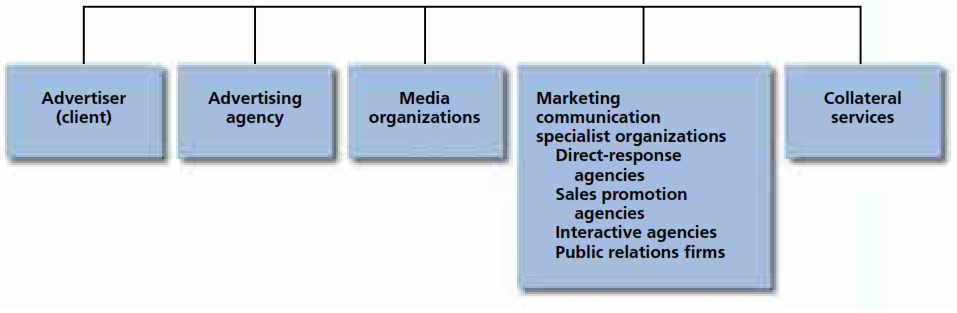
The development, execution and administration of an advertising and promotions program involve the efforts of many individuals, both within the company and outside it. The following schematic shows the Participants in the Integrated Marketing Communications process:
To understand this better, envision a scenario where P&G is the Advertiser (client), which is using J. Walter Thompson as its Advertising agency for its Tide brand. The role of a Media organization is to provide an environment for the firm's marketing communications message. The media must have editorial or program content that attracts consumers so that advertisers and their agencies will want to buy time or space with them. The next group of participants are organizations that provide specialized marketing communications services. They include direct-marketing agencies, sales promotion agencies, interactive agencies, and public relations firms. The final participants shown in the promotions process are those that provide collateral services, the wide range of support functions used by advertisers, agencies, media organizations, and specialized marketing communications firms. These individuals and companies perform specialized functions the other participants use in planning and executing advertising and other promotional functions.

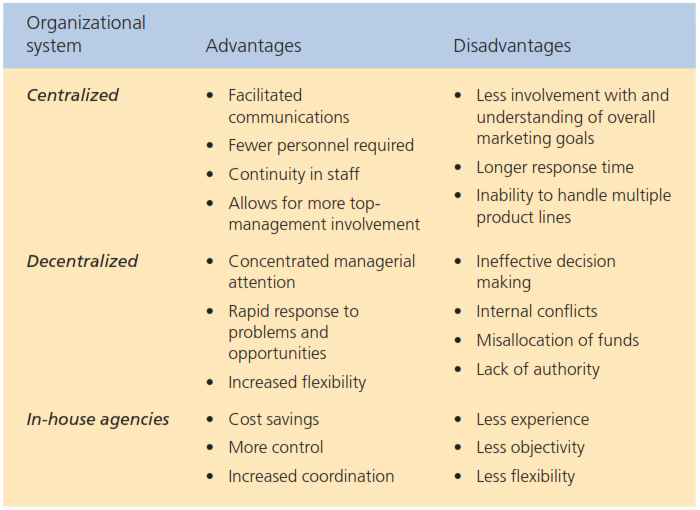
Companies use three basic systems to organize internally for advertising and promotion:
1. Centralized system: The most common example of a centralized system is when the advertising manager controls the entire promotions operation, including budgeting, coordinating creation and production of ads, planning media schedules, and monitoring and administering the sales promotions programs for all the company’s products or services.
2. Decentralized system: Popular in large corporations with multiple divisions and many different products. Consist of separate manufacturing, research and development, sales, and marketing departments for various divisions, product lines, or businesses. Assign each product or brand to a brand manager who is responsible for the total management of the brand, including planning, budgeting, sales, and profit performance. There may be additional layers of category managers above them, like in P&G.
3. In-house agencies: An in-house agency is an advertising agency that is set up, owned, and operated by the advertiser. Some in-house agencies are little more than advertising departments, but in other companies they are given a separate identity and are responsible for the expenditure of large sums of advertising dollars. E.g. Calvin Klein.

The figure below shows the advantages and disadvantages of using one of the above 3 systems of advertising  organization systems:

Types of Ad agencies:
Full-service agencies - Offers the client a full range of services, including creative, account, marketing, financial and management services.
Creative boutiques - Specialize in creative services.
Media buying services - Specialize in media buying.

These agencies are typically compensated through a commission system which works somewhat similar to the depiction below:

However, increasingly marketers are using an performance incentive based compensation system for paying ad agencies.

Saturday, 22 September 2012

VALs model


The Value-attitude-lifestyle model of customer segmentation.

Wednesday, 19 September 2012

Self Introduction- Monika V


A Brief introductory Video about me and my institute, Indian Institute of Management, Shillong.

Introductory Video - Manavendra Roy Choudhury

We are Group N

We are Group N of the PGP 2011-13 batch of the Indian Institute of Management, Shillong. Over the course of the next few days, we will be publishing our views and learnings from the course of Integrated Marketing Communication through the medium of this blog.